
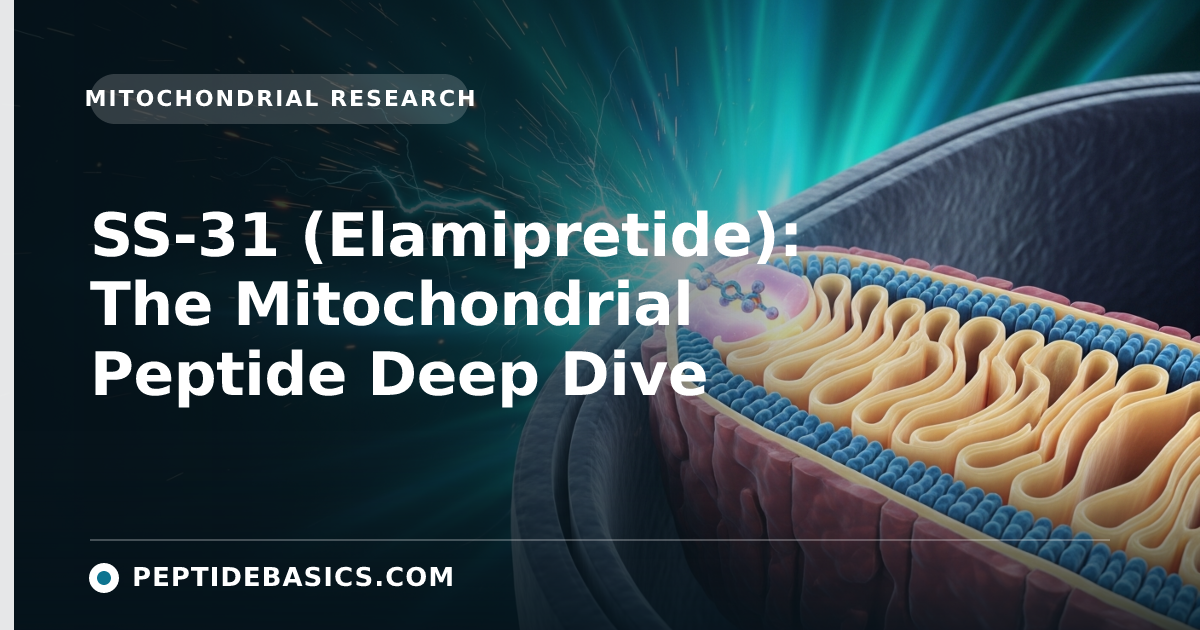
SS-31 (Elamipretide): The Mitochondrial Peptide Deep Dive
SS-31 — known clinically as elamipretide — is one of the most studied mitochondria-targeting peptides. By binding cardiolipin in the inner mitochondrial membrane, it aims to restore the cellular energy machinery itself. Its story is a fascinating mix of elegant mechanism, genuine clinical promise, and the hard reality of trials that repeatedly missed their primary endpoints. Here is the full picture.
Research use only — not an approved drug. SS-31 / elamipretide is investigational and not FDA approved for any condition. Wellness claims about "cellular energy" or anti-aging are not supported by approved human evidence. This article is educational and not medical advice.
Also known as
Elamipretide, MTP-131, Bendavia
Drug class
Mitochondria-targeting peptide
FDA approved
No — under regulatory review
Target
Cardiolipin (inner mito membrane)
History & Discovery
Szeto-Schiller peptides discovered
SS-31 belongs to a family of aromatic-cationic tetrapeptides developed by Hazel Szeto and Peter Schiller at Cornell. Its sequence (D-Arg-2'6'-dimethyltyrosine-Lys-Phe-NH2) was engineered to be cell-permeable and to concentrate selectively in the inner mitochondrial membrane — an unusual targeting property for a peptide.
Cardiolipin as the target
Researchers identified that SS-31 binds cardiolipin, a phospholipid unique to the inner mitochondrial membrane that is essential for the structure of cristae and the efficiency of the electron transport chain. This explained how a single peptide could broadly improve mitochondrial bioenergetics.
Stealth BioTherapeutics develops elamipretide
The compound was licensed and developed clinically as elamipretide (also called MTP-131 and, in cardiac ischemia trials, Bendavia) by Stealth BioTherapeutics, targeting diseases driven by mitochondrial dysfunction.
Clinical program across multiple diseases
Trials spanned primary mitochondrial myopathy, Barth syndrome, dry age-related macular degeneration, heart failure, and ischemia-reperfusion injury — with mixed results that defined both the promise and the limits of mitochondrial-targeted therapy.
Clinical Trial Evidence
MMPOWER-3 (Primary Mitochondrial Myopathy)
Phase 3The pivotal Phase 3 trial did NOT meet its primary endpoints (6-minute walk test and symptom score) in the overall population. A sobering result that highlighted how difficult mitochondrial disease endpoints are to move and measure.
TAZPOWER (Barth Syndrome)
Phase 2/3The randomized crossover phase missed its primary endpoint, but the open-label extension reported improvements in functional and cardiac measures over longer treatment — forming the basis of the ongoing regulatory case for Barth syndrome.
ReCLAIM (Dry AMD / Geographic Atrophy)
Phase 1/2Early signals on certain retinal function and structural measures supported further study of mitochondrial protection in retinal disease, though it did not establish a definitive approvable benefit.
Cardiac / Heart Failure studies
Phase 2Studies in acute ischemia-reperfusion (as Bendavia) and heart failure with reduced ejection fraction produced inconsistent results, illustrating the gap between strong preclinical mitochondrial data and human clinical endpoints.
FDA Approval Process
SS-31 / elamipretide is NOT an FDA-approved drug. It remains investigational. Material sold as 'SS-31' for research is unapproved and unregulated, and is not a treatment for any condition.
Stealth BioTherapeutics has pursued FDA approval of elamipretide for Barth syndrome — an ultra-rare genetic mitochondrial disease — using data from TAZPOWER and its open-label extension. The pathway has involved FDA advisory committee review and the complexities of demonstrating benefit in a tiny patient population where standard endpoints are hard to power.
Mitochondrial dysfunction underlies many diseases, but it is diffuse and hard to measure. Clinical endpoints (walk tests, symptom scales) are noisy, patient populations are small and heterogeneous, and biomarkers don't always translate to felt benefit. Several SS-31 trials missed primary endpoints despite coherent mechanistic data — a recurring theme in the field.
Mechanism of Action
SS-31 is cell-permeable and, due to its alternating aromatic-cationic structure, accumulates 1,000–5,000-fold in the inner mitochondrial membrane without requiring a membrane potential — meaning it can reach even depolarized, damaged mitochondria.
It binds cardiolipin, the signature phospholipid of the inner membrane. Cardiolipin organizes the proteins of the electron transport chain and maintains the tightly folded cristae structure where ATP is produced. In disease and aging, cardiolipin becomes peroxidized and disorganized.
By protecting cardiolipin, SS-31 helps preserve cristae architecture and the supercomplexes of the respiratory chain — improving electron flow, ATP synthesis efficiency, and reducing electron 'leak.'
Less electron leak means fewer reactive oxygen species (ROS). SS-31 is therefore studied as both a bioenergetic enhancer and a targeted antioxidant — addressing the vicious cycle in which damaged mitochondria produce more ROS, which causes further damage.
Downstream Effects
Known / Documented
- Improved mitochondrial respiration and ATP production in preclinical and ex vivo models
- Reduced mitochondrial reactive oxygen species (targeted antioxidant effect)
- Functional/cardiac improvements in the Barth syndrome open-label extension
- Generally well tolerated in trials; injection site reactions are the most common adverse effect
- Missed primary endpoints in several large trials (mitochondrial myopathy, some cardiac studies)
Speculative / Under Study
- Anti-aging interest — mitochondrial decline is a hallmark of aging; human longevity data does not exist
- Neuroprotection in neurodegenerative disease (preclinical interest, unproven clinically)
- Kidney protection in acute injury and chronic kidney disease (preclinical models)
- Skeletal muscle function and exercise capacity in aging (early research)
- Retinal protection in macular degeneration (signals seen, not yet definitive)
- Broad 'cellular energy' claims in the wellness market are not supported by approved human evidence
Related reading:
- → What is mitochondria, and why is it important?
- → Are peptides safe?
- → Browse the full peptide database
Other Articles
Calculator
Calculate exact reconstitution volumes and insulin unit doses for any peptide protocol.
Open Calculator →